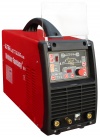
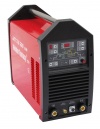
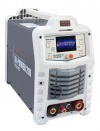
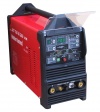
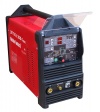
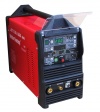
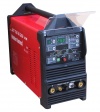
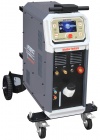
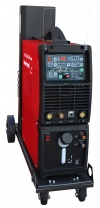
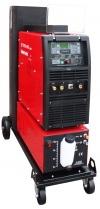
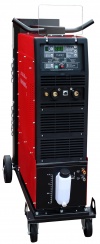
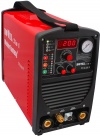
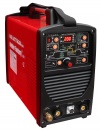
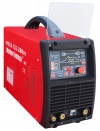
How the TIG 500A welder with a cooler works:
1. Power supply and arc ignition:
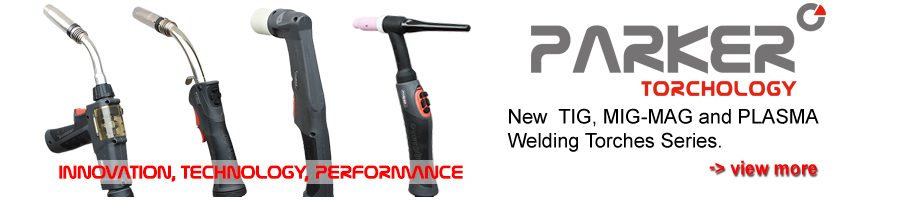
The welder supplies current to the TIG torch, which is connected to the negative terminal, while the ground clamp is connected to the positive terminal.
The tungsten electrode, heating up to the melting point of tungsten (3380°C), generates the welding arc.
This arc melts the filler and the base material, creating a welding pool.
2. Cooler:
For high-power TIG welders, such as those up to 500A, the welding torch is subjected to very high temperatures.
The cooler, often using liquid (e.g., water with coolant), flows through the torch, effectively dissipating excess heat.
This prevents the torch and cables from overheating, ensuring stability and durability of operation, thus increasing the efficiency of the device.
3. Welding process:
The welder controls the movement of the TIG torch and, if needed, manually feeds additional material.
The shielding gas is released before, during, and after the welding process, protecting the weld from oxidation and ensuring good joint quality.
After finishing the work, the electrode is separated from the material, and the cooling system continues to operate to completely cool the torch.
Which 500A TIG welder to choose?
When choosing a TIG welder up to 500A with a cooler, key criteria include: the range of welding currents (dependent on the thickness and type of material), availability of AC/DC mode for welding different metals (especially aluminum), adjustment of parameters such as frequency and balance of AC current for aluminum, and the presence of a cooler for prolonged use. The ability to expand the welder's functions, e.g., with spot welding cycles or pulse, is also important.
1. Type and range of current (AC/DC)
When selecting TIG welds, consider the types of materials being welded. For welding aluminum and its alloys, alternating current (AC) is necessary, as it effectively removes the oxide layer from the aluminum surface. Direct current (DC) is used for welding steel, stainless steel, and other metals.
For welding steel with a thickness of 1 mm, a current of 40 to 50 A is needed, and for aluminum, from 40 to 75 A. Adjust the current to ensure sufficient power for welding the required materials.
2. AC parameters for aluminum
The higher the frequency set, the better the filler is concentrated, and the higher the quality of the weld obtained. The optimal range is often 80-120 Hz, but many professional welders allow adjustment within 60-200 Hz and more.
This parameter determines the ratio between the "positive" and "negative" currents. The balance is particularly important when welding aluminum, as it affects the lifespan of the electrode and the quality of the weld.
3. Cooling and cooling system
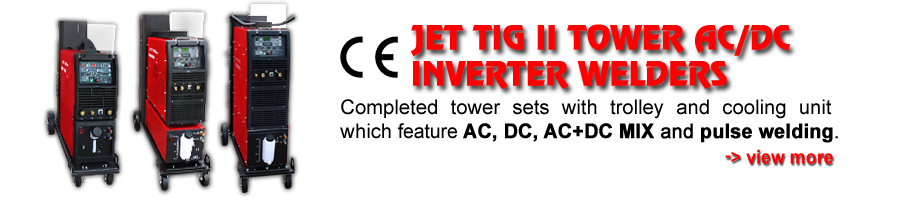
High-current TIG welders (up to 500 A) require a liquid cooler to prevent overheating of the torch during prolonged use.
Check if the selected welder has access to a liquid cooler and if it is compatible with the given model.
4. Additional features
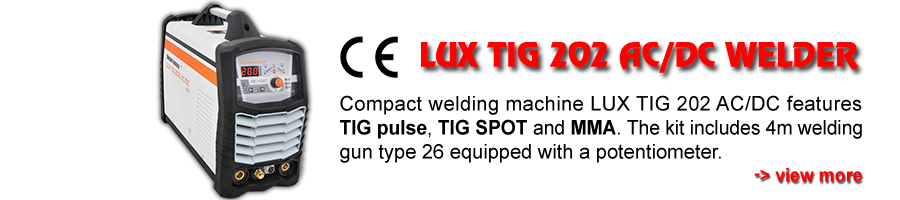
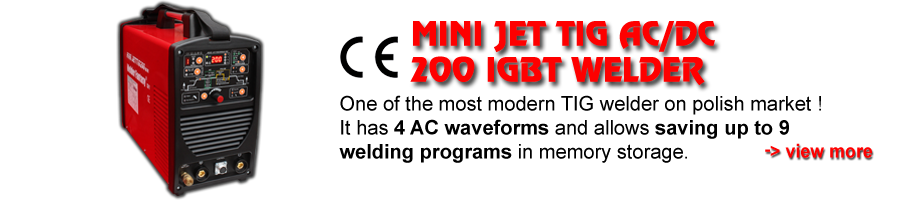
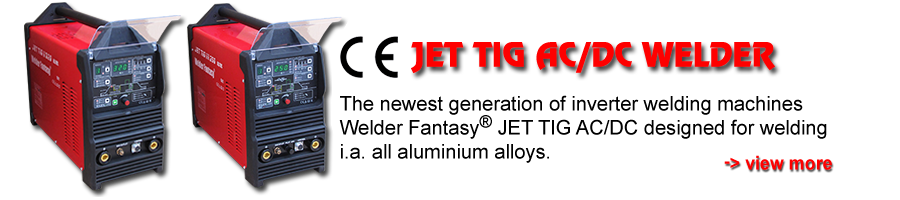
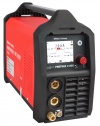
Some models of TIG welders offer features that facilitate welding thin sheets and spot joining, e.g., the Weldes Fantasy JET TIG 200-S welder.
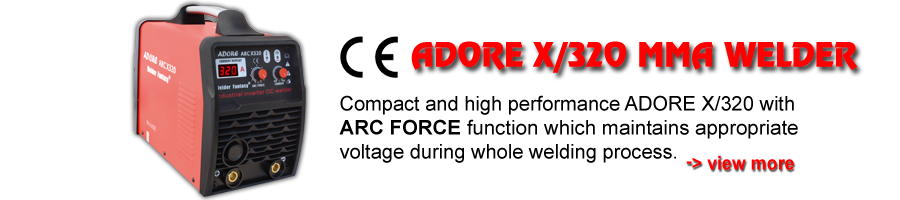
Check if external control is available, allowing for quick parameter changes during welding using a foot pedal or potentiometer located in the welding torch. This option is available in all models of Welder Fantasy JET TIG series welders.