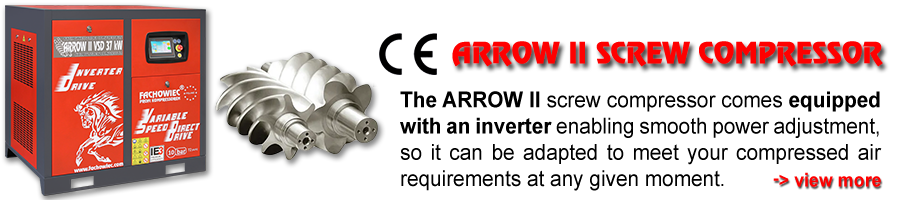
Looking for a high-class 7.5 kW screw compressor? Do you care about high efficiency and continuous work? Discover our range of screw compressors that provide you with high output, reliability and low running costs.
Construction of a screw compressor
- Electric motor: Drives the screw rotors, transferring power through a coupling or belts.
- Screw rotors: Two interlocking rotors (main and auxiliary) with screw profiles.
- Housing/Chamber: Surrounds the rotors, creating compression spaces.
- Oil supply system: Doses cooling oil to the compression spaces.
- Oil separator: A tank where oil is separated from compressed air.
- Aftercooler: Cools the air before it is released into the system.
- Air filter and separator: Used to purify air and oil.
Operating principle of the screw compressor
- Suction: Air from the surroundings is drawn through the filter into the compressor chamber.
- Compression: The screw rotors rotate, trapping air in the spaces between the rotors and the housing.
- Volume reduction: As the rotors turn, the volume of these spaces gradually decreases, causing an increase in air pressure.
- Lubrication and cooling: Oil is injected into the compression space, which serves to seal, lubricate, and absorb heat from the compression process.
- Separation: Compressed air along with oil flows to the separator, where oil is separated from the air.
- Cooling and purification: The air passes through the aftercooler and is then directed to further filters.
- Discharge: Compressed, cooled air flows out through the discharge valve and is directed to the system.
Criteria for selecting a screw compressor
To select a 7.5 kW screw compressor, you need to determine the required air flow (capacity) and working pressure, taking into account the type of pneumatic tools used and the intensity of work. Pay attention to technical parameters such as drive (e.g., direct for greater efficiency), noise level, lifespan of the screw block, and availability of spare parts. Choose a reputable manufacturer with good quality workmanship that will ensure a long lifespan of the device.
1. Determine the compressed air needs
- Capacity (air flow): Consider what pneumatic tools will be powered by the compressor and how much air they need. A power of 7.5 kW is suitable for demanding working conditions and professional applications where a large amount of compressed air is needed.
- Working pressure: Typically, 7.5 kW screw compressors can reach up to 10 bar, which is sufficient for many tools and production lines. Check if this is appropriate for your tools.
2. Technical parameters of the compressor
- Drive: Direct drive is preferred, which eliminates energy losses associated with belt drive, resulting in greater efficiency and longer compressor lifespan.
- Noise: Screw compressors can be quieter than piston ones, but it's worth checking the noise level generated during operation, especially if you work near other people or in rooms where noise limits apply.
- Lifespan: Check the declared lifespan of the screw block.
3. Other important factors
- Quality of workmanship and manufacturer: Choose compressors from reputable brands, as the materials used affect the durability and reliability of the device.
- Availability of spare parts: Ensure that spare parts are readily available, which will facilitate servicing and ensure continuity of operation.
Additional features:
Some models offer a compact design that saves space or 2-in-1 features, combining key elements in one device, e.g., bundled with a dryer and air filters.









 Continue shopping