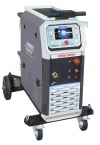
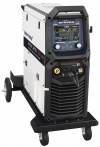
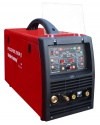
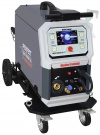
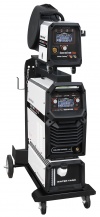
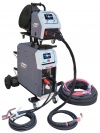
Device and Welding Process Description
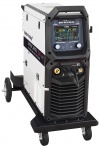
1. Semi-automatic welder:
Unlike traditional methods, the MIG/MAG welder continuously supplies the electrode (wire), requiring only the movement of the torch along the joint.
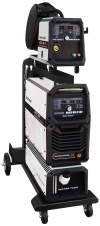
2. Large wire spool:
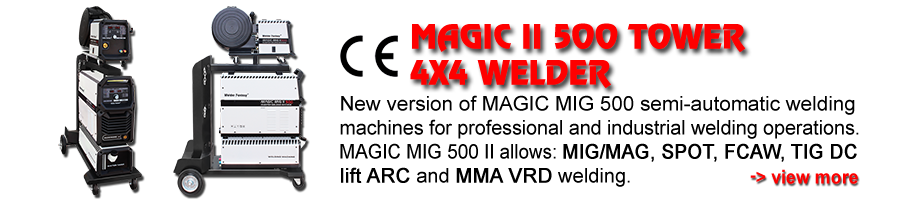
The device accommodates large wire spools (e.g., 15 kg, fi-300), allowing the welder to work longer without frequent material changes.
3. Wire feeding mechanism:
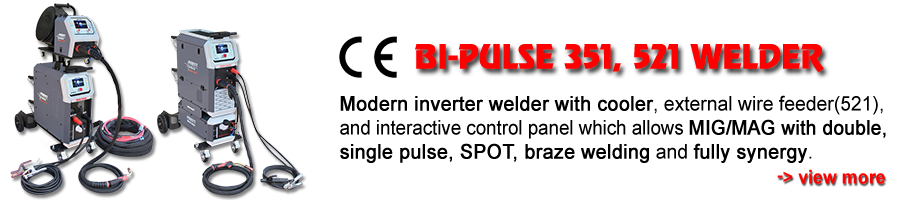
An internal or external (for larger machines) wire feeder is responsible for smooth and precise delivery from the welding torch.
4. Shielding gas:
It is essential to protect the molten metal from air exposure, preventing contamination and the formation of defects.
5. Electric arc:
It is generated between the wire tip and the welded element, melting the electrode and base material to create the weld.
6. Continuous operation:
In the MIG/MAG method, the length of the electrode remains constant, making it easier to maintain the welding arc and allowing for longer welding processes.
Applications and Advantages of Welders with Large Wire Spool Feeders
The MIG/MAG method allows for fast welding of large sections, which is efficient in production and assembly.
It enables welding of various materials, including low-carbon steels, alloys, aluminum, and copper, as well as brazing.
Large spools reduce downtime for wire changes, increasing work efficiency.
Features such as synergy and 2T and 4T welding (for longer stitches) facilitate work.
Type and Thickness of the Welded Material
Smaller wire diameters (e.g., 0.6-0.8 mm) are dedicated, and 230V welders are sufficient for welding.
- Thick materials (>10 mm):
Require stronger welders with higher amperage (e.g., 300 A) and larger wire spools, e.g., 1.6 mm or larger.
Type of Method (MIG/MAG) and Shielding Gas
- MIG welder (Metal Inert Gas):
Uses inert gases, e.g., argon, for welding non-ferrous metals such as copper or aluminum.
- MAG welder (Metal Active Gas):
Uses active gases, e.g., CO2 and argon mixtures, for welding structural steel and steel alloys.
Parameters of the Welder for Large Wire Spools
- Maximum welding current (Amperage):
The thicker the material, the higher the current needed (e.g., 1 mm of material = approx. 40-50 A).
Determines the efficiency of the device – the higher the cycle (e.g., 60%), the longer it can weld under load without overheating.
4-roll feeders are standard in industrial devices for large spools (e.g., 15 kg) and ensure stable wire feeding.
Required for large wire spools, industrial welders need 3-phase power (400V), while single-phase 230V is sufficient for home use.
When choosing a MIG/MAG welder for large wire spools, key criteria include: type and thickness of the welded material (determines welder power and wire diameter), type of shielding gas (MIG for inert gases, MAG for active), maximum welding current (the thicker the material, the higher the current), duty cycle (reflects efficiency at a given current), type of wire feeder (4-roll for heavy loads and 15 kg spools), and power supply (3-phase 400V for industrial work).