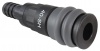
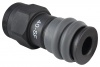
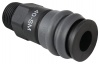
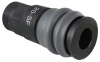
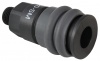
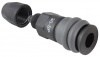
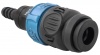
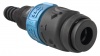
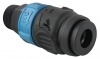
Composite pneumatic quick couplings are components that allow for quick and convenient connection or disconnection of hoses in pneumatic systems, such as supplying compressed air to machines and tools. They consist of two parts: a socket and a plug. The socket is usually equipped with a shut-off valve, a locking mechanism (e.g., balls or rollers), and seals, while the plug is the end of the hose. Their composite construction (often using plastics like polyamide) ensures lightness and resistance to corrosion and mechanical damage.
Construction of composite quick couplings
- Socket:
- Body: The main housing made of composite materials with metal elements,
- Shut-off valve: A built-in valve that closes the airflow when the coupling is disconnected, preventing uncontrolled leakage.
- Locking mechanism: Usually consists of balls and springs that lock the plug in the socket. To disconnect, the outer sleeve or ring must be retracted, which releases the balls.
- Seals: Usually made of materials such as NBR, ensuring a tight connection at various pressures.
- Plug: The element that slides into the socket. It has a profile matched to the locking balls in the socket. It is equipped with a fitting for connecting a hose or a thread for connecting to another component.
- Materials: Composite: Often used plastics, such as polyamide, which provide lightness, corrosion resistance, and are relatively inexpensive.
Applications of composite quick couplings
- Industry: Automated production lines. Assembly and machining stations.
Powering pneumatic tools (e.g., wrenches, screwdrivers, grinders). Transport systems.
- Workshops and service centers: Quick change of pneumatic tools. Connecting a compressor to various receivers.
- Others: Anywhere quick and repeated connection/disconnection of pneumatic hoses is necessary without the use of tools, e.g., in vehicles equipped with pneumatic drive.
Selection criteria
To choose the appropriate pneumatic quick couplings, attention should be paid to the nominal diameter, working pressure, flow, operating temperature, and type of connection. Composite fittings are lighter and do not feel cold to the touch; however, it is important to ensure that the material is resistant to working conditions.
- Nominal diameter (DN): It should be matched to the diameter of the hose or pipe (e.g., 8, 10, 12mm), or thread ¼” or ½”.
- Working pressure: The fitting must withstand the maximum pressure present in the system.
- Flow: It is important that the flow is appropriate for the tool requirements (given in l/min at a specified pressure and pressure drop).
- Operating temperature: Choose a fitting that will operate within the temperature range present in the environment and medium.
- Type of connection: Available fittings with a hose tree or threaded, screwed. It is worth considering "safe" fittings that prevent sudden air release.
- Resistance to environmental factors: Ensure that the material (in this case, composite) is resistant to moisture, dirt, and other factors typical of the working environment.