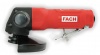
Construction and operation principle of the pneumatic angle grinder:
1. Pneumatic motor:
In the pneumatic angle grinder, compressed air drives a vane motor that generates rotations.
2. Angle gearbox:
The motor's rotations are transferred to the spindle, to which the grinding disc is attached. The angle gearbox, located in the head, changes the direction of rotation by 90 degrees, allowing the disc to be mounted in the correct position.
3. Spindle and disc:
The spindle, driven by the gearbox, rotates the grinding disc, which performs the material processing work.
4. Disc guard:
The guard protects the operator from sparks and dust generated during operation. It is important never to remove the guard.
5. Additional handle:
Many grinders have an additional handle that improves comfort and precision during work.
Applications:
Pneumatic angle grinders are used in various industries, such as:
- Automotive: Cutting and grinding body elements, welds, etc.
- Industry: Metal processing, cutting pipes, profiles, and other materials.
- Construction: Surface preparation for welding, rust removal, cutting and grinding building materials.
- Installation work: Cutting and processing pipes, profiles, etc.
Advantages of pneumatic angle grinders:
- Compact size and low weight: Facilitate work in hard-to-reach places.
- High durability: Longer lifespan compared to electric grinders.
- Safety: No risk of electric shock and the ability to work in explosive environments.
- Adjustable speed: Allows matching the speed to the type of material being processed.
- Higher efficiency and lower vibrations