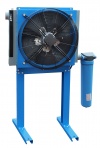
Secondary compressed air coolers are used to cool the air after compression, which allows a significant amount of moisture (condensate) to be removed and improves air quality. They consist of a heat exchanger (most often made of copper tubes with aluminum fins) and a fan (in air-cooled versions) or a water circuit. Hot compressed air flows through the exchanger, transferring heat to a cooler medium (ambient air or water), which causes water vapor to condense and then be removed by a separator.
Construction and operation of secondary coolers
- Heat exchanger: The main element, often made of pipes through which compressed air flows. In the case of air coolers, these pipes are covered with fins, which increases the heat exchange surface.
- Cooling medium: This can be:
- Air: An axial fan forces air flow from the environment through the exchanger, removing heat from the compressed air.
- Water: A water cooler uses a water circuit to cool compressed air.
- Condensate separator: A device that follows the cooler. It separates condensed water from compressed air.
- Automatic condensate drain: Connected to the separator, it automatically removes condensed water from the system.
What are secondary coolers used for
- Moisture removal: The main goal is to remove a large portion of moisture from the compressed air, which protects the installation and tools from corrosion and damage.
- Equipment protection: Cooling the air prevents overheating of pneumatic tools and other devices connected to it.
- Increased efficiency: Lower humidity in compressed air improves the performance of the devices that use it.
- Preparation for further processing: Cooled air is ready for subsequent stages of treatment, such as adsorption drying.
Which cooler to choose?
To choose a secondary compressed air cooler, one must consider the operating parameters of the system, such as pressure and air flow, as well as the specific application requirements. It is crucial to match the dimensions and construction of the cooler (number and diameter of pipes, fin density, core thickness) to the original to ensure proper cooling performance. It is advisable to consult an expert or supplier to obtain optimal device selection that will ensure maximum efficiency and durability.
Key parameters to consider:
- System operating parameters: Consider the pressure and flow of compressed air that needs to be cooled.
- Specific application requirements: The application of the cooler may have different requirements, e.g., in hydraulic or ventilation systems, which affect its selection.
- Construction and materials: The cooler should have the appropriate core thickness, number and diameter of pipes, as well as fin density corresponding to the parameters of the original cooler to ensure effective cooling.
- Type of cooler: Choose the appropriate type of cooler, e.g., single-phase or two-stage, depending on the needs and requirements of the system.
Recommendations:
Consultation with an expert: To make an optimal selection of the device that will ensure maximum efficiency and durability, it is recommended to consult an expert or supplier.