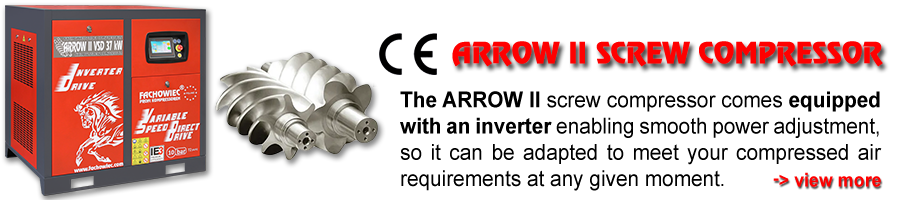
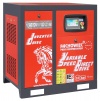
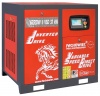
Do you want to optimise performance and operating costs of your compressed air system? Do you want access to exactly the amount of compressed air you really need, without paying for excess production? If so, check our offer of screw compressors with frequency inverter.
Screw compressors with an inverter have a standard compressor construction (two rotating screw rotors that compress air), to which an inverter (frequency converter) has been added to control the motor speed. They are used to generate compressed air in industrial plants, where there are variable demands for it, allowing for energy savings and lower operating costs by matching performance to needs.
Construction of a screw compressor with an inverter
- Electric motor: Drives the screw assembly.
- Screw module: Consists of two screw rotors that, while rotating, draw in and compress air in the compression chamber.
- Inverter (frequency converter): This is a key component that smoothly regulates the motor speed.
- Air filter: Draws in air and filters it before delivering it to the screw module.
- Cooling and separation system: Oil injected into the screw module cools, seals, and lubricates the rotors, and is then recovered in the separator.
- Intake valve: Controls the airflow to the compressor depending on its demand.
How does it work?
- Air is drawn in through the intake valve with the air filter.
- In the screw module, the two rotors begin to rotate, reducing the volume of the space and increasing the pressure of the drawn air.
- The inverter dynamically adjusts the motor speed to the current demand for compressed air, optimizing energy consumption.
- Compressed air, after passing through the cooling and oil separation system, is directed to the air tank and then to the user's pneumatic network.
What are screw compressors with inverters used for?
- Energy efficiency: The inverter allows for reduced electricity consumption by matching the compressor's performance to the momentary demand.
- Low operating costs: Lower energy consumption directly translates to lower electricity bills.
- Longer lifespan: Reduced load on the motor and mechanisms during partial load operation extends the device's durability.
- Constant pressure: Despite variable air demand, the compressor maintains stable pressure in the system.
- Noise reduction: Depending on demand, the inverter can lower the rotational speed, which reduces the noise level generated by the compressor.
How to choose?
To choose a screw compressor with an inverter, you need to determine the demand for compressed air (performance and working pressure) for your devices, and then compare this value with the technical parameters of available models. It is worth paying attention to energy efficiency, operating costs, service availability, and the manufacturer's lifespan, as well as considering whether VSD (Variable Speed Drive) technology is suitable for the specifics of your application.
1. Determine the demand for compressed air
- Performance (l/min, m³/h): You need to know the demand for compressed air from all tools and processes that will use it.
- Working pressure (bar): Check what pressure is required by your devices (most often 6-8 bar, but it's worth verifying).
2. Understand the benefits of the inverter (VSD)
- Energy efficiency: The inverter allows the compressor to adjust its speed to the current demand, significantly reducing energy consumption, especially with variable air intake.
- Pressure stability: Ensures constant pressure in the installation, regardless of fluctuations in demand, which is crucial in many production applications.
- Continuous operation: Compressors with inverters are ideal for continuous operation, where the demand for compressed air is irregular.
3. Key parameters and features to assess
- Actual performance: Check how the actual performance of the compressor (in relation to its maximum pressure) meets your needs.
- Total cost: Consider both the purchase cost and operating costs (energy, service), similar to buying a car.
- Warranty and service: Check how long the warranty lasts and whether spare parts are readily available.
- Noise level: Ensure that the noise level generated by the compressor is acceptable for your work environment.
4. Selection criteria
- Application specifics: Choose a compressor tailored to specific industries (e.g., painting, manufacturing, medicine), where pressure stability and air quality are important.
- Comparison with other models: Compare the parameters of several models from different manufacturers before making a final decision.