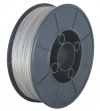
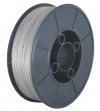
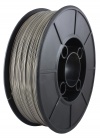
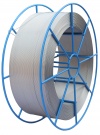
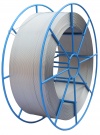
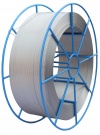
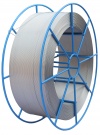
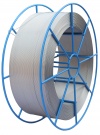
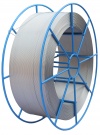
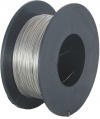
Chromium-nickel wire description:
- Composition:
This wire is characterized by its content of chromium and nickel, usually in proportions close to 18% Cr and 8% Ni, which corresponds to the composition of stainless steels. The addition of silicon (Si) in the designation LSi improves welding properties, such as wetting, which facilitates the creation of smooth and aesthetic joints.
- Applications:
- Chromium-nickel MIG/MAG wire is used for welding:
- Stainless steels (e.g., 18-8).
- Acid-resistant steels.
- Alloys.
- Pipelines, tubes, and boilers in the chemical, food, pharmaceutical industries, as well as in energy.
- Advantages:
- High corrosion resistance, including intergranular corrosion.
- Good joint strength.
- Ability to weld in various positions.
- Stable welding arc and low spatter.
Designations:
Typical designations are ER308LSi and ER316LSi. L indicates reduced carbon content, which increases resistance to intergranular corrosion, and Si indicates the addition of silicon.
Types:
For welding stainless steels of type 18-8, including 304, 304L, 302, 321. Used in the food, chemical, and petrochemical industries.
For welding stainless steels containing molybdenum (e.g., 316, 316L), which increases resistance to corrosion in aggressive environments, such as acidic environments and at elevated temperatures.
There are also other grades of chromium-nickel wires, tailored to specific alloying requirements and applications, e.g., ER309LSi for welding steels with different chemical compositions (e.g., joining stainless steel with carbon steel).
Additional information:
Chromium-nickel MIG/MAG wire is typically wound on spools (e.g., D100, D200, D300).
The choice of the appropriate wire depends on the chemical composition of the welded material, the thickness of the material, the welding position, and the requirements for the joint.
During welding, it is essential to use shielding gas (e.g., argon or a mixture of argon with carbon dioxide).