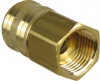
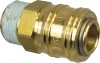
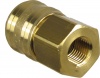
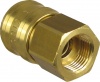
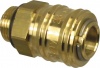
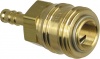
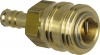
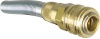
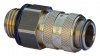
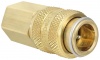
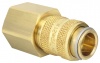
Rectus pneumatic quick couplings are made of two parts: a plug (male) and a socket (female) connected by a latching mechanism. They are used for quick and safe connection and disconnection of pneumatic hoses in compressed air systems. Their main task is to enable efficient operation by allowing instant connection of tools and easy disconnection of installations, while preventing air leaks through automatic valve closure.
Construction of RECTUS quick couplings and connectors
- Connector, Plug (male part): This is an element ending with, for example, a thread or a fitting (tree for hose), which connects to the socket.
- Quick coupling, Socket (female part): Contains a latching mechanism that locks the plug upon connection.
- Latching mechanism: Usually based on a ball system, allows for instant connection and disconnection without the use of tools.
- Valves: In versions with shut-off, valves are located in both the socket and the plug. They close automatically during disconnection, minimizing medium loss.
- Seals: High-quality seals ensure the tightness of the connection, preventing leaks.
- Material: Connectors are made from various materials, e.g., brass (the most popular models), stainless steel, providing corrosion resistance depending on the application.
Applications of RECTUS quick couplings
- Connecting and disconnecting: They allow for instant connection and disconnection of pneumatic tools such as impact wrenches, drills, grinders, or spray and blow guns.
- Pneumatic systems: Commonly used in compressed air installations in industry, workshops, or laboratories.
- Specialized applications: There are versions for special applications, e.g., panel connectors for mounting on panels, or models with minimized sizes for applications with limited space.
How to choose?
To choose the right Rectus quick coupling, you need to determine the type of connection (e.g., pneumatic), size, and standards (e.g., ISO types, safety). You should also consider the material of construction (brass, stainless steel, plastic) depending on the working environment, functions (e.g., one-way/two-way shut-off), and the required air flow.
Key selection criteria
- Purpose and type of connection: Pneumatic: Standard applications are pneumatic quick couplings, but other sizes are also available.
- Size and standard: Choose the size of the quick coupling appropriate for the diameter of the hose (e.g., 6 mm, 8 mm, 10 mm). The most popular among pneumatic tools is the 26 standard.
- Check compliance with standards (e.g., ISO) depending on the application requirements.
- Material: Nickel-plated brass: A good combination of strength and corrosion resistance, but more expensive than plastic. Stainless steel: Very high chemical resistance and durability, but also a higher price. Plastic: a suitable option for less demanding applications, provided the material is of good quality.
- Functions: Two-way shut-off: Minimizes air loss when the coupling is disconnected. One-way shut-off: Valve on one side, preventing air loss. Flow-through: No valves, ensuring maximum air flow.
- Safety requirements: In areas prone to injury or high noise levels, use special safe quick couplings.