Key parts of the TIG torch and their descriptions:
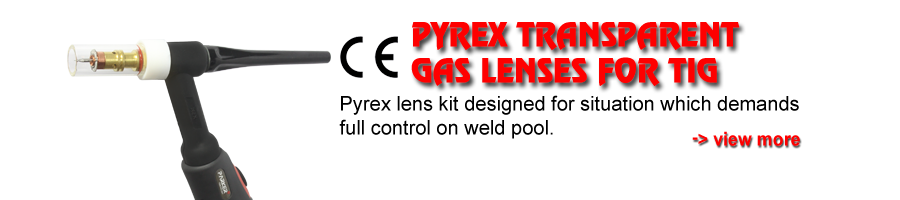
- Gas nozzle (ceramic, glass, gas lens): Controls the flow of shielding gas, protecting the electrode and the weld pool from the atmosphere. Various types and sizes are available, e.g., ceramic nozzles, TIG lenses, quartz lenses according to spawalnictwo.pl.
- The TIG current connector is a key consumable part of TIG welding torches, responsible for transmitting electrical current to the tungsten electrode and supplying shielding gas, ensuring precise and high-quality welds. This connector secures and clamps the collet, as well as allows for the installation of nozzles.
Description and application of the TIG current connector:
The main task of the TIG current connector is to transmit electrical current from the power source to the tungsten electrode, which is a non-consumable welding wire. This is crucial for the formation of the welding arc and melting the material.
The current connector connects the body of the welding torch to its current tip, ensuring the proper operation of the entire assembly.
In addition to transmitting current, this connector supplies and distributes shielding gas (e.g., argon, helium) to the torch nozzles, protecting the welding area from oxidation.
- Dimensions and selection:
TIG current connectors come in various diameters (e.g., 1.6 mm, 2.4 mm, 3.2 mm), which should be selected based on the diameter of the tungsten electrode used and the type of torch.
- The TIG collet is a key component of the welding torch, responsible for securing the tungsten electrode in the correct position, allowing for a stable and precise welding arc. These collets also provide an electrical contact point between the torch and the electrode, which is essential for current flow during welding.
Description and function:
The main task of the collet is to securely clamp the tungsten electrode in the torch socket, ensuring its stable retention during the welding process.
The collet serves as a conductive element that allows current to flow from the power source to the tungsten electrode, initiating and maintaining the welding arc.
Collets are standard, replaceable parts in TIG welding torches and are available in various sizes, tailored to the diameter of the tungsten electrode used.
They are typically made from heat-conductive materials such as brass or copper, which are resistant to high temperatures.
Many collets are produced to the Binzel standard, ensuring their versatility and compatibility with various models of TIG torches.
TIG collets are used in TIG welding torches, both gas-cooled and liquid-cooled.
They are essential for welding a wide range of materials, including stainless steels, aluminum alloys, and nickel, as well as thin sheets.
- The TIG cup is a structural element of the welding torch that serves to support the tungsten electrode in the correct position and distance from the welded surface, ensuring stability of the welding arc during TIG (tungsten inert gas) welding. It is usually made from high-temperature resistant plastic, and its size (short, medium, long) is matched to specific series of TIG torches (e.g., SR 9/20, SR 17/18/26) and manufacturers (e.g., Trafimet, Binzel, Lincoln).
Application of the TIG cup:
- Supporting the tungsten electrode:
The main function of the cup is to securely hold the electrode in the torch, which is crucial for the precision of TIG welding, allowing for clean and high-quality welds, especially on stainless steel, aluminum, or titanium.
- Protection of the electrode:
The cup also serves a protective function for the tungsten electrode, safeguarding it from mechanical damage.
- Ensuring the flow of shielding gas:
The proper shape and fit of the cup affect the correct flow of shielding gas around the electrode, which is essential for protecting the weld pool from oxidation.
- Various types and lengths:
Cups are available in various lengths (short, medium, long) and types, allowing them to be tailored to specific applications and welder preferences, e.g., for welding in hard-to-reach places.