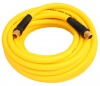
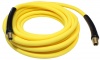
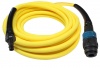
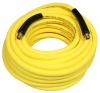
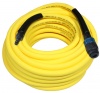
Hybrid polymer hose for compressed air is a type of flexible, durable hose that combines the advantages of different polymer materials (such as polyurethane and PVC) with reinforcement, for example nylon, to provide resistance to abrasion, chemicals, low temperatures and twisting. This makes it a universal choice for industrial and workshop applications.
Hybrid construction: The hose is made of a special blend of polymers that combines the best features of various materials. It often combines polyurethane and PVC, reinforced with woven or braided nylon.
Exceptional flexibility: Even at low temperatures, the hose remains flexible and does not stiffen, making it easier to work in various conditions and preventing it from cracking.
High durability and resistance: Hybrid hoses are resistant to abrasion, mechanical damage, the effects of oils, UV radiation, and ozone.
Twist resistance: Thanks to the hybrid material blend, the hose does not twist or bend, which facilitates handling and extends its lifespan.
Lightweight: Hybrid hoses are usually lighter than traditional rubber hoses, making them easier to carry and use.
Universal application: They are ideal for connecting compressors and pneumatic tools, used in workshops, service centers, paint shops, or industry.
Typical applications
Powering pneumatic tools.
Distributing compressed air in manufacturing plants and service centers.
Working in industrial conditions requiring high durability and resistance to environmental factors.
When choosing a hybrid polymer hose for compressed air, it is important to select the diameter according to the tool and the length that minimizes pressure loss while providing freedom of movement. Hybrid hoses are a good option due to their good price-to-quality ratio, and they are durable, resistant to abrasion and oil. It is also worth paying attention to the working pressure and operating temperature, which can affect the hose's lifespan.
Key factors in selection
Inner diameter: Depends on the tool used. For standard workshop wrenches, 7 to 10 mm is sufficient, and for more powerful tools, 13 mm and above.
Length: Shorter hoses minimize pressure loss, but choose one that allows for freedom of work.
Damage resistance: Hybrid polymer hoses are a good choice because they are resistant to abrasion and oils, which is crucial in automotive workshops.
Working pressure: Check if the hose can withstand the pressure in your installation (e.g., 6-8 bar in standard workshops).
Temperature: Ensure that the hose can withstand the temperatures present in the workplace (e.g., from -20 °C to +60 °C in professional hoses).
Material quality: Hybrid polymer hoses are a compromise between durability and price.
Why choose a hybrid hose?
Price-to-quality ratio: They offer a good compromise between price and durability, making them an economical choice for general applications.
Durability: They are very durable, resistant to abrasion and the effects of oils, ensuring a long lifespan.
Ease of handling: They are flexible and easy to handle, which facilitates work.