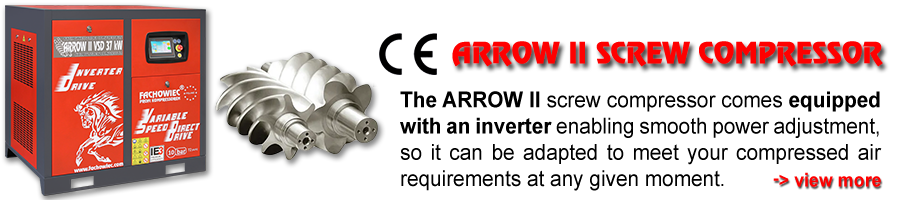
Screw compressors 16 bar operate on the principle of positive displacement, where two interlocking screw rotors rotate, drawing in and trapping air in increasingly smaller chambers, leading to an increase in pressure. Oil-injected versions use oil for lubrication, cooling, and sealing components, which is then separated from the compressed air in the tank and cooled before returning to the circuit.
Construction of the screw compressor
- Screw rotors (from English: screw): Two rotors (male and female) with a special, spiral shape that interlock, creating compression chambers.
- Housing: A closure for the rotors that minimizes air loss and ensures optimal operating conditions.
- Electric motor: Drives the rotors, usually through a belt or gear drive.
- Intake filter: Removes solid particles from the air drawn in from the environment.
- Lubrication and cooling system: Contains oil, pumps, coolers, and oil filters.
- Oil separator: A tank where oil is separated from the compressed air after passing through the screw stage.
- Final cooler: Cools the compressed air after oil separation.
- Control system: An electrical assembly with a pressure transducer that regulates the operation of the compressor.
Operating principle
- Air intake: Atmospheric air flows through a filter that cleans it of contaminants.
- Compression: The cleaned air enters the compression chamber, where interlocking screw rotors reduce the volume of the space, increasing the air pressure.
- Rotor rotation: The air is trapped and transported along the rotors to the outlet of the screw stage.
- Oil injection: During compression, oil is injected into the space between the rotors, which lubricates, cools, and seals the components of the screw stage.
- Separation and cooling: The mixture of compressed air and oil goes to the separator, where most of the oil is separated. The air then flows through the cooler, and the cooled oil is directed back into circulation.
- Air transport: The compressed and cooled air is further treated (e.g., through additional filters or dryers) and delivered to the installation.
Where are 16 bar screw compressors used?
16 bar screw compressors are used to power pneumatic devices in industry, construction, automotive, and for processes requiring clean, compressed air, such as painting, packaging, or powering tools in production. The high pressure of 16 bar is ideal for applications that require high power, such as in laser cutters or pneumatic tools.
What are 16 bar screw compressors used for:
- Powering pneumatic tools and machines: In automotive workshops, construction, and machinery industry, compressed air powers tools such as impact wrenches, drills, or hammers.
- Production processes: In the food industry for inflating PET bottles or vacuum packaging, as well as in the chemical and pharmaceutical industries, where compressed air is needed for transport and production processes.
- Painting and sandblasting: Require high and stable pressure, which is provided by compressed air.
- Laser cutters: High-pressure compressed air is essential for the proper operation of fiber-type cutters and other lasers.
- Blowing and cleaning: In production processes, compressed air is used for blowing and removing contaminants.
- Maintaining pressure in systems: In many industrial installations, compressed air is used as a medium to maintain constant pressure.
Why 16 bar?
A pressure of 16 bar is relatively high, making screw compressors with this value suitable for applications where:
- High power: To operate tools and machines with high energy demand.
Precision and cleanliness: Some applications, such as laser cutters or the production of sensitive components, require air with high purity and precise parameters.