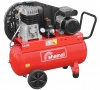
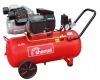
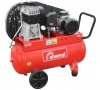
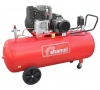
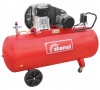
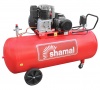
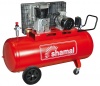
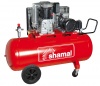
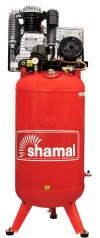
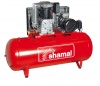
Looking for a high-quality piston compressor with 10 bar pressure? Explore our range of Shamal compressors, one of the leading Italian manufacturers. As an exclusive distributor for Poland we offer a wide selection of models with tank capacities from 25 to 500 litres.
The construction of a 10 bar piston compressor includes a motor, a compressor block with a cylinder and piston, valves (suction and discharge), a crankshaft, and a pressure tank.
The principle of operation is based on the reciprocating motion of the piston, which draws in air through the open suction valve during the downward stroke and compresses it during the upward stroke, closing the suction valve and opening the discharge valve, directing the compressed air to the tank, where it reaches a pressure of up to 10 bar (in two-stage compressors, this process is more efficient).
Construction
- Motor: Drives the crankshaft, which moves the piston.
- Compressor block: Consists of a cylinder and a piston that moves back and forth.
- Valves: Two types:
- Suction valve: Allows air into the cylinder during the downward motion of the piston.
- Discharge valve: Pushes compressed air from the cylinder to the tank when the piston moves upward.
- Crankshaft: Converts the rotational motion of the motor into the reciprocating motion of the piston.
- Pressure tank (bottle): Stores compressed air until use. The pressure in it is controlled by a pressure switch, which turns the compressor on and off as needed.
- Pressure switch: Automatically controls the pressure in the tank, starting and stopping the compressor.
- Check valve: Prevents the backflow of compressed air from the tank to the unit.
- Regulating valve: Allows setting and maintaining a specific, lower working pressure for tools connected to the compressor.
Principle of operation
- Suction: The piston moves down the cylinder. A vacuum is created, which opens the suction valve, allowing air from the surroundings (after filtration) to flow into the chamber.
- Compression: The piston starts moving upward. The suction valve closes. The decreasing volume of the chamber causes the air to compress, and its pressure rises sharply.
- Discharge: When the pressure in the cylinder exceeds the pressure in the tank, the discharge valve opens. Compressed air is pushed out of the cylinder and directed to the tank.
- Storage: Air is stored in the pressure tank. When the pressure reaches a programmed value (e.g., 10 bar), the pressure switch automatically turns off the motor.
- Repeatable cycle: When the pressure in the tank drops below a set threshold, the pressure switch restarts the compressor, and the cycle repeats.
Two-stage compressors: In the case of compressors achieving higher pressures (e.g., 10 bar and above), the air after the first compression stage can be cooled and directed to the second cylinder for further compression. This action improves efficiency and reduces the temperature of the air.
To choose a 10 bar piston compressor, one should pay attention to its effective performance (l/min), which should be about 30% higher than the tool demand, and the tank capacity (l), matched to the type of work (larger cups are better for tasks requiring stable pressure). The motor power (kW/HP), noise level, as well as the type of power supply and mobility are also crucial.
Application tips
- For home use: Even for home applications, a 10 bar compressor offers greater pressure reserves and is more versatile than 6-8 bar models.
- For specialized work (e.g., painting, workshop): Pay special attention to performance and tank capacity to ensure constant pressure during operation.
For professional applications: Choose models with high power and efficiency, preferably with large cups that ensure continuous operation.