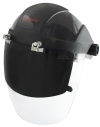
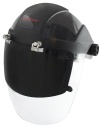
Masks for plasma cutting protect the operator's eyes, face and respiratory tract against harmful UV/IR radiation, fumes, sparks and hot spatter. They are usually full-face shields with filters or darkening.
Eye protection: Masks filter harmful UV and IR radiation generated during plasma cutting.
Face and neck protection: They protect the face from splashes, hot particles, and sparks.
Respiratory protection: They provide protection against inhaling toxic fumes and metal particles generated during cutting.
Impact protection: Depending on the design, masks also protect against impacts from particles of varying energy.
Construction
Face shield: This is the main part of the mask that protects the face and eyes. It can be made of polycarbonate or other durable materials.
Filter:
Auto-darkening welding filters: Automatically switch from light to dark state when the welding arc appears, and return to light state after it extinguishes.
Gas and combined filters: Used to protect against specific gases and vapors, as well as in combination with particulate filters.
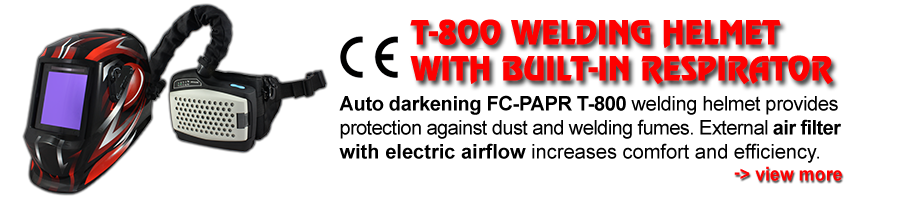
Forced air circulation systems: Provide a supply of clean air to the mask, increasing comfort and protection in difficult working conditions. They can be integrated with head, shoulder, and even hearing protection.
Headgear or helmet: Depending on the model, the mask can be mounted on a self-supporting headgear or a protective helmet.
For plasma cutting, choose a welding face shield with auto-darkening function or a mask with the appropriate filter that will protect the eyes and respiratory tract from harmful fumes and metal particles. It is also essential to have the ability to adjust the shade of the filter (a lighter shade, e.g., 9-13, is usually used for plasma cutting) and to ensure a tight fit of the mask to the face.
Welding Face Shield
Auto-darkening face shield: This is the best choice as it protects the entire head and offers the ability to adjust the degree of darkening, which is crucial for plasma cutting, and also has a grinding mode.
Filters: Ensure that the face shield filter has the appropriate parameters for plasma cutting. Lighter shades (e.g., 9-13) are often used for this purpose compared to traditional welding.
Certification: Check if the face shield has CE certifications and standards EN 379 (for filters) and EN 175 (for shields).
Filtering half mask (in combination with the face shield or instead of it)
Filter: This is an ideal solution that protects against 99.97% of dangerous airborne particles during plasma cutting.
Protection class: Choose masks with the highest protection class, e.g., class 3 (FFP3), which provides 99% filtration against solid and liquid particles with high toxicity.
Optional absorbers: Depending on the specifics of the work, absorbers for organic/inorganic vapors and acidic gases can be used.
Mask Fit
Sealing: The mask must fit tightly to the face to prevent harmful substances from entering the respiratory system.
Correct size: To choose the right size, measure the circumference of your head to fit the mask to your face.
Additional Tips
Plasma cutting vs. other methods: Plasma cutting requires lighter filter shades than arc welding. Ensure that the face shield is adapted for this process.
Ventilation: Plasma cutting generates harmful fumes, so in addition to the mask, ensure proper ventilation of the workplace.