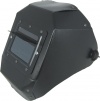
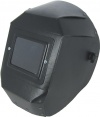
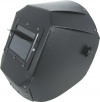
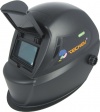
What passive helmets are used for:
- Eye and face protection: They provide basic protection against UV radiation, sparks, and intense light generated by the welding arc.
- Support in MMA and MIG/MAG welding: Due to their simplicity and lower price, passive helmets are often recommended for MMA (stick welding) and semi-automatic welding (MIG/MAG).
- Amateur and occasional use: Due to the need for manual lifting and lowering of the helmet, they are more suitable for welders who work less frequently or in conditions where constant monitoring of work progress is not necessary.
How standard welding helmets work and what their features are:
- Fixed shading: Unlike auto-darkening helmets, they have built-in glass with a fixed, predetermined level of shading.
- Manual operation: The welder must manually lower the helmet before starting to weld and then lift it to see the results of their work.
- Lower price: They are usually significantly cheaper models compared to automatic helmets, which is their main advantage.
- Glass replacement option: The level of shading can be changed by replacing the installed glass in the helmet with another one that has a different shading level.
To correctly choose a regular, i.e., passive welding helmet, pay attention to comfort and fit (weight, adjustment, soft materials, sweatband), field of vision (size of the filter cassette), and the type of welding for which it will be used (MIG/MAG, MMA, TIG). Remember that occasional home projects do not require investing in professional equipment, and in case of doubts, it is worth consulting a specialist.
Key factors when choosing a passive helmet:
- Type of welding: Different methods (MIG/MAG, MMA, TIG) generate different radiation intensities, so the helmet must provide the appropriate level of shading for the chosen method.
- Type of filter: In passive helmets, it is the tinted glass according to standards depending on needs and situations, e.g., 9, 10, 11.
- Field of vision: The standard field of vision for home applications is about 5 x 10 cm.
- Comfort and fit:
- Weight: A lightweight helmet prevents neck pain and fatigue.
- Adjustment: The helmet should fit snugly to the head but not press too hard.
- Materials: Parts that come into contact with the skin should be made of soft materials.
- Sweatband: Protects against excessive sweating and improves work comfort.
When to choose a passive helmet:
For occasional work: If you weld sporadically, e.g., at home, investing in expensive, automatic equipment is not necessary.
As a supplement: A passive helmet can be a good option if you already know your "safe" range of work and do not need adjustments.
In summary: Before making a purchase, consider what tasks you will use the helmet for, what welding methods you will employ, and what your budget is. In case of doubts, consult a specialist at a welding shop.