Factors to consider when purchasing a tungsten electrode grinder:
- Type of electrodes: Make sure the grinder is suitable for your electrodes. For example, red electrodes with thorium oxide are intended for direct current (DC), while green ones (made of pure tungsten) are for alternating current (AC).
- Work intensity: If you do a lot of work, consider purchasing a high-performance electric grinder.
- Size and diameter of electrodes: Grinders are designed for different sizes of electrodes.
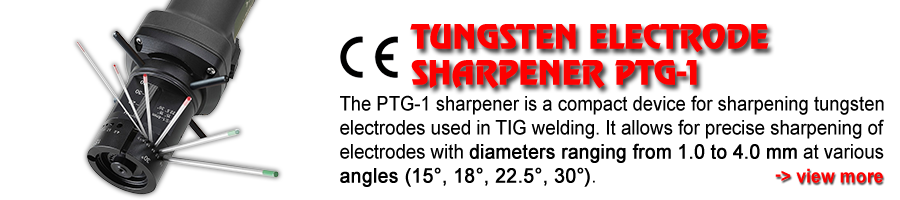
- Precision: If you care about very precise grinding, choose a grinder with adjustable sharpening angle.
Types of tungsten electrode grinders:
- Electric grinders: They operate on electricity and are often equipped with a wet cooling feature, which is particularly important for frequent sharpening.
- Manual grinders: Simple devices that can be a good option for occasional use.
Tungsten electrode sharpening technique:
Tungsten electrodes are sharpened mechanically, preferably on a special tungsten electrode grinder. Care should be taken for respiratory safety (especially with thoriated electrodes) and to avoid overheating tungsten by frequently dipping it in water.
- Preparation and sharpening technique
Tool selection: The best solution is to use a special tungsten electrode grinder that provides precise and repeatable sharpening.
- Angle setting: Sharpening is done by holding the electrode at an angle of 15-30 degrees to the surface of the wheel (for DC).
- Sharpening along the axis: Apply the electrode to the wheel and rotate it along its own axis to create a symmetrical cone.
- Longitudinal scratches: Ensure that longitudinal scratches are formed on the surface of the electrode, not transverse ones, which can lead to arc instability.
- Rotating and cooling: Lift the electrode from the stone, rotate it in the air, and then apply it again. In case of overheating, dip the electrode in water.
Important tips when sharpening tungsten electrodes
- Safety: When grinding tungsten electrodes, especially those with thorium additives, it is essential to ensure respiratory safety by using appropriate masks or ventilation systems.
- Stable arc: A well-sharpened electrode provides a stable arc, better weld quality, and deeper material penetration.
- Alternating current (AC): When welding with alternating current, the tip of the electrode may be slightly rounded. It can also be shaped into a ball by briefly striking an arc on clean material, then turning off and cooling.