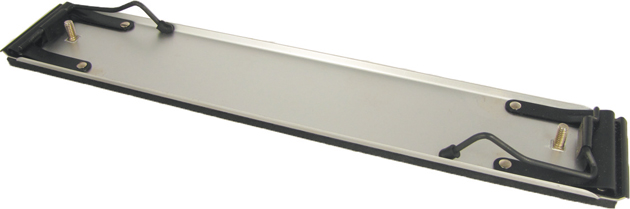
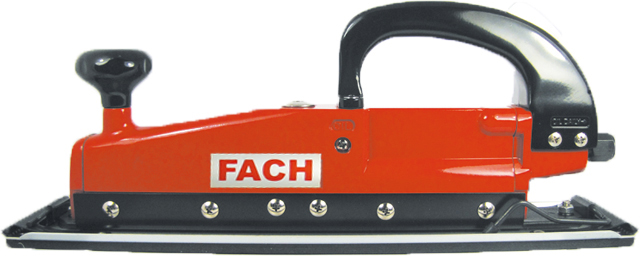
Linear pneumatic grinders are used for precise machining of metal and other materials, for example to smooth large roof or car door surfaces, welds, remove rust or perform finishing work. Their design consists of a body, a control valve for compressed air, a motor and an interchangeable working head (vibrating pad).
Smoothing large surfaces to achieve a uniform finish without local irregularities.
Finishing and removing welds: They allow for precise smoothing and removal of welding marks.
Removing corrosion: They are excellent at cleaning metal surfaces from rust and other contaminants.
Precision finishing: They are used for precise sanding and shaping of components, e.g., in renovation work, modeling, or crafts.
How they are constructed
Body: Usually a durable body with a two-handed handle shaped like a plane, containing a motor and a control valve.
Pneumatic drive: Powered by compressed air supplied through a hose from a compressor.
Motor: Inside the body, there is a motor that converts the energy of compressed air into oscillating motion.
Control valve: Typically activated by a lever or trigger, it controls the airflow to the motor.
Working head (pad): A sanding disc of various sizes depending on the model and manufacturer as well as the application.
How to choose a pneumatic linear sander?
Criteria for choosing a pneumatic linear sander include the type and nature of work, tool power, size and type of pad/disc, and oscillation stroke. It is also important to match the tool to the available compressor and check the pressure (PSI/BAR) and airflow (CFM/LPM) requirements.
Criteria for choosing a sander:
Type of work:
Consider whether you need a sander for: Smoothing and finishing: Choose a sander with the appropriate pad and oscillation stroke.
Quick processing of large surfaces: Look for a tool with a larger pad and universal oscillation stroke.
Size and type of pad/disc: Match the size to the surface you want to process. A larger pad means greater efficiency, but also potentially greater weight of the tool. Ensure that the disc has the appropriate type of attachment (e.g., Velcro).
Number and oscillation stroke: Number of oscillations: The higher the number of oscillations per minute, the more efficiently the sander works. For example, the linear sander Fachowiec achieves 2100 oscillations per minute.
Oscillation stroke: Selected depending on the purpose. A smaller stroke (mm) is ideal for finishing work, while a larger one is more versatile.
Compatibility with the compressor: Check if the compressor provides the appropriate parameters for the given sander. Pressure (PSI/BAR): Most sanders operate optimally at 6.2 BAR. Ensure that the compressor can maintain a constant pressure.
Airflow: Sanders typically require about 320 LPM, but exact requirements vary by model.
Ergonomics and weight: Pay attention to weight and maneuverability, especially if you plan to work in tight spaces or for extended periods.
Additional features: Consider additional features that may make work easier.