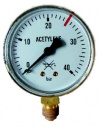
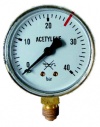
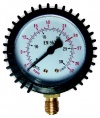
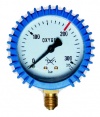
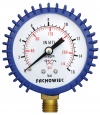
Cylinder regulator gauges are used to measure and display gas pressure in the cylinder and after reduction. They are usually based on an elastic Bourdon tube that deforms under pressure, and this movement is transferred to a pointer moving over a scale. Regulators usually have one or two gauges: one measures cylinder pressure (gas content), and the other measures working pressure after reduction.
Construction of manometers
- Bourdon tube: This is a key element in the construction of most mechanical manometers. It is a bent, flattened tube with an oval cross-section that tends to straighten under the influence of gas or liquid pressure.
- Lever mechanism: The straightening motion of the Bourdon tube is converted into the rotational movement of the pointer using a system of levers and gears.
- Dial with scale: The pointer moves across a graduated dial, indicating the current pressure value in units (e.g., bar, MPa).
- Housing: Protects the internal parts of the manometer.
Diaphragm manometer (less common type): In some manometers, pressure is measured using a flexible diaphragm that deforms under pressure and transmits the movement to the pointer mechanism.
Function and application
- Monitoring pressure in the cylinder: The manometer on the inlet side shows how much gas remains in the cylinder, monitoring the high inlet pressure.
- Controlling working pressure: The manometer on the outlet side allows precise setting and control of the working pressure of the gas supplied to the device (e.g., welding torch).
- Ensuring safety: Continuous pressure monitoring allows the operator to react quickly in case of problems, preventing equipment damage and minimizing the risk of accidents.
Enabling precise adjustment: Manometers allow for precise adjustment of operating parameters to the requirements of a specific technological process, which is crucial, among other things, in welding.
How to choose the right manometer?
To choose manometers for cylinder regulators, they must be matched to the type of gas, working pressure, and required measurement range, as well as pay attention to the accuracy class (e.g., 0.6) and safety standards. Usually, two manometers are mounted on the regulator: one for measuring the pressure in the cylinder and the other for indicating the working pressure.
Factors to consider:
- Type of gas: The regulator and manometer must be suitable for the specific gas, e.g., argon, CO2, oxygen, or acetylene.
- Pressure: Choose a manometer that covers both the cylinder pressure (high) and the working pressure (low). Two manometers are often used to indicate both values simultaneously.
- Measurement range: The range of the manometer should be adjusted to the pressure you will be working with. For example, a manometer for working pressure should have an appropriate range, e.g., from \(0\) to \(0.05\) MPa.
- Accuracy class: The manometer should have an appropriate accuracy class, e.g., class 0.6, which determines its precision. The lower the percentage value, the smaller the measurement error.
- Safety standards: Ensure that the product meets the relevant safety standards (e.g., EN 5171).
- Additional features: Depending on your needs, you can choose regulators with additional features such as a shut-off valve, heater, or rotameter.
- Quality and reputation of the supplier: Order equipment from a reputable supplier to ensure high quality of workmanship and tightness.