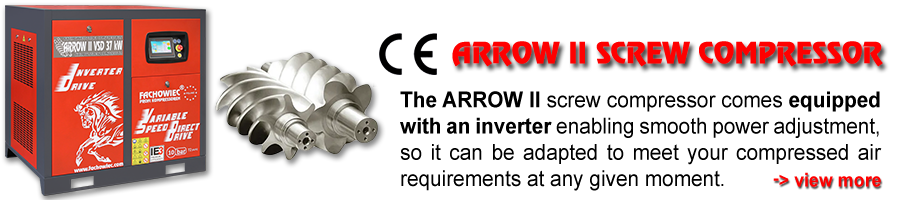
Do you need a professional 30 kW screw compressor? Are you looking for a high-quality unit for workshop, industrial or other demanding applications? We recommend our ARROW and ARROW II VSD series units, which in terms of design and quality are on a par with the best systems on the market.
The 30 kW screw compressor uses two interlocking screw rotors (male and female) placed in a housing to compress air. Air is drawn in and transported along the rotors, and the decreasing volume of the chambers between them increases its pressure. In oil-injected compressors, oil is used for cooling, sealing, and lubrication, and after compression, it is separated in a separator, while the compressed air flows to the cooler and network.
Construction of the screw compressor
- Screw mechanism: This is the heart of the compressor, consisting of two rotors: male and female, which interlock in the housing.
- Rotors: They have a spiral shape, and their interlocking creates variable volumes in which air is trapped. The male rotor usually has fewer teeth and rotates faster.
- Housing: Surrounding the rotors is a housing to which oil is supplied.
- Drive: An electric motor drives one of the rotors, while the other is driven by interlocking.
- Air filter: Cleans the air drawn from the environment of solid particles.
- Suction regulator: Along with the valve, it regulates the airflow to the compression stage.
- Oil separator: After compression, oil is separated from the air in the separator.
- Cooler: Cools the compressed air before delivering it to the network.
Operating principle of screw compressors
- Air intake: Air from the environment is drawn into the compressor through the air filter.
- Compression: In the screw stage, the rotating rotors draw in air and transport it along their axes. Between the teeth of the rotors and the housing, chambers of variable volume are formed, and as they rotate, the volume of these chambers decreases, causing an increase in air pressure.
- Oil injection: Oil is injected into the compression chamber, which serves the purpose of lubrication, sealing, and cooling of the screw stage.
- Separation and cooling: The mixture of air and oil goes to the oil separator, where the oil is separated. Then, the compressed air is directed to the cooler to cool it to a temperature suitable for the network.
- Delivery of compressed air: After cooling and cleaning, the compressed air is sent to the installation.
Criteria for selecting a screw compressor:
To choose a good 30 kW screw compressor, it is essential to first determine the required working pressure and the total demand for compressed air in the company, considering the types of tools and processes. Then, select a model with appropriate performance with a certain margin, keeping in mind the need to ensure adequate ventilation for the compressor room and sufficient electrical protections. Pay attention to the quality of the compressed air and the possibilities for continuous operation.
1. Define the demand for compressed air:
- Calculate the total demand: sum up the amounts of air needed for all tools and processes that will be powered by the compressor.
- Include a margin: add an appropriate reserve to the calculated total to ensure stable pressure and smooth operation.
2. Determine the required pressure:
- Verification of working pressure: ensure that the compressor will deliver the pressure necessary for all connected tools and processes.
- Check the pressure in the installation: In a new installation, pressure drops in the pipelines should also be considered.
3. Pay attention to the specifics of the application:
- Continuous operation: screw compressors are designed for continuous operation, so it is important that their power and performance are suited to constant demand.
- Air quality: In industries such as food or medical, high quality of compressed air is crucial, which affects the choice of the appropriate air treatment system.
4. Ensure appropriate working conditions:
- Ventilation of the compressor room: a 30 kW compressor requires adequate ventilation of the room in which it is installed.
Electrical protection: Ensure that the existing electrical protections at the installation site are sufficient for the power of the compressor.




















 Continue shopping