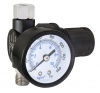
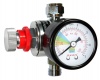
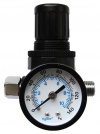
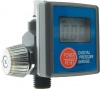
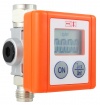
The spray gun regulator is used to reduce and stabilize the pressure of compressed air supplied to the gun, ensuring precise output pressure, which is crucial for the quality and efficiency of painting. It resembles a small, often metal device with a pressure gauge for reading pressure, an adjustment knob, and standard pneumatic connections, most commonly 1/4 inch, for direct mounting under the gun.
What is the purpose of a spray gun regulator?
- Precise pressure regulation: It allows for setting a constant, optimal air pressure for a specific spray gun, enabling repeatable work results.
- Pressure stabilization: Regardless of pressure changes in the compressor, the regulator maintains a constant output pressure, preventing painting issues such as uneven paint application.
- Gun protection: It prevents the supply of excessively high pressure that could damage the tool or negatively affect its operation.
- Improvement of painting quality: Maintaining the correct pressure is crucial for proper paint atomization, resulting in a smooth and aesthetic finish of the surface.
What does a spray gun regulator look like?
- Pressure gauge: This is a readable dial, usually scaled in bars and PSI, showing the output pressure (after adjustment).
- Adjustment knob: Located on the side of the device, it is used to turn and set the diaphragm or piston, allowing for precise adjustment of the output pressure.
- Connections: It has standard pneumatic connections, most commonly G 1/4 inch, which allow it to be connected to the air hose and gun.
- Diaphragm or piston: Inside the device, there is a component (diaphragm or piston) that responds to pressure changes and regulates the airflow, maintaining the set pressure.
- Compact design: Spray gun regulators are usually small and lightweight, allowing for unobstructed movement of the operator and can be mounted directly under the gun.
How to choose the right spray gun regulator?
To choose the right spray gun regulator, select a model with an appropriate pressure range (usually 1-6 bars) and a thread compatible with the hose and gun (often 1/4"). It is crucial that the regulator provides accurate and stable air pressure regulation, which should match the manufacturer's recommendations for the gun and the type of surface being painted, excluding pressure losses caused by too thin or long a hose.
1. Check the requirements of the gun and paint
- Manufacturer's recommendations: First of all, check the user manual of the spray gun to find out what air pressure is recommended for a specific model and type of paint.
- Type of gun: HVLP (High Volume Low Pressure) guns require lower pressures (1-2 bars) and more air, while high-pressure guns operate at higher pressures (2-3.5 bars).
2. Select the pressure range and threads
- Pressure range: Choose a regulator with a pressure adjustment range that covers your gun's requirements, e.g., from 1 to 6 bars.
- Thread size: Check the thread size on the hose and gun to select a regulator with the appropriate thread (e.g., 1/4").
3. Ensure adequate airflow
- Compressor performance: Remember that the regulator works best with a sufficiently efficient compressor that provides a constant supply of air with adequate flow.
- Hose thickness: Use hoses of appropriate diameter (e.g., 8 mm or more) to avoid pressure losses on long or thin lines.
4. Consider filtration and drainage
Drain/Filter: In addition to the regulator, it is worth investing in a drain or air filter that ensures clean and dry air, protecting the gun and paint from moisture.
Summary
A good regulator should provide precise pressure regulation, be connected to an efficient compressor and clean air, and most importantly, should be tailored to the requirements of your painting equipment and the surface being painted.