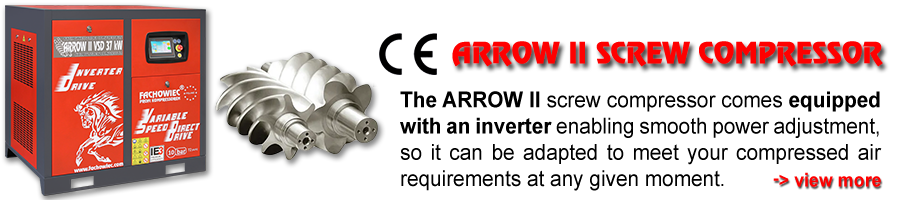
Looking for a high-class 5.5 kW screw compressor? Do you care about high performance and continuous operation? Check our offer of screw compressors that provide you with high efficiency, reliability and low operating costs.
Construction of a screw compressor
The basic elements of a screw compressor are:
- Screw rotors: Two interlocking rotors with a screw profile, driven by a motor.
- Housing: A cylindrical housing that contains the rotors and forms variable volume chambers with them.
- Electric motor: Drives the rotors and is the power source for the compressor.
- Suction regulator: A control valve that regulates the airflow to the compression stage, adjusting to the demand of the system.
- Oil supply system: Delivers oil to the compression mechanism, which performs lubrication, cooling, and sealing functions.
- Oil separator: A tank where compressed air is separated from oil.
- Aftercooler: Cools the compressed air before it is delivered to the network.
Operating principle of the screw compressor
- Air intake: Atmospheric air is drawn in through the air filter to the compression stage.
- Oil injection: Oil is injected into the space between the rotors in the compression stage.
- Compression process: Rotating rotors reduce the volume of chambers trapped between the threads, which causes a gradual increase in air pressure.
- Oil separation: The compressed mixture of air and oil is directed to the separator, where most of the oil is separated from the air.
- Cooling: The air leaves the separator and passes through the aftercooler, where it is cooled.
- Delivery of compressed air to the network: The cleaned and cooled compressed air is pumped into the pneumatic system.
- Oil recirculation: Oil from the separator is returned through a pipe to the compression stage.
Criteria for selecting a screw compressor
When selecting a 5.5 kW screw compressor, consider its airflow (capacity) and maximum working pressure tailored to the application requirements, as well as operating times and the need for continuous operation. The quality of filtration and cooling system is also important for the longevity and cleanliness of the compressed air, as well as the noise level and the presence of automation and control functions for user convenience.
Key selection criteria:
- Performance (airflow): Determine how much air you need per unit of time (e.g., l/min, m³/h) to choose a compressor that meets the demand of machines and tools in your process.
- Working pressure: Ensure that the compressor achieves the pressure (e.g., in bars) required by your pneumatic tools and processes.
- Operating time and usage intensity: Consider whether the compressor will operate continuously or only periodically, as screw models are ideal for intensive applications requiring continuous operation.
- Quality of compressed air (filtration and cooling): Check if the compressor has effective cooling and filtration systems that remove contaminants, oils, and moisture, ensuring longer device life and cleaner air.
- Noise level: For applications in quiet workplaces, pay attention to the noise level (measured in decibels) and choose a model with lower sound intensity.
- Control and automation: Advanced controllers allow for remote monitoring and control of operating parameters, enhancing user comfort and efficiency.
- Purpose and application: Screw compressors are a good choice for industry and professional applications, offering efficiency and reliability in continuous operation.
















 Continue shopping