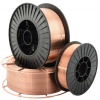
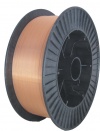
Types of MIG/MAG welding wires for steel:
Most commonly used for welding low-carbon steels, such as SG2 (G3Si1) and SG3 (G4Si1).
SG2 is universal, while SG3 has a higher silicon and manganese content, providing better weld properties. Used with CO2 gas shielding or Ar/CO2 mixtures. Available in various diameters, e.g., 0.8 mm, 1.0 mm, 1.2 mm.
Contain flux in the core, which melts during welding, creating a shielding gas that protects the weld from oxidation.
Can be used with or without shielding gas (self-shielding).
They perform well in difficult conditions (e.g., outdoors) and when welding stainless steel.
- Wires for stainless steel:
Designated by symbols ER308/308L, ER316/316L, ER309/309L. Selected based on the grade of stainless steel being welded. Can be solid or cored.
- Wires for high-alloy steel:
Contain alloying additives (e.g., chromium, nickel, molybdenum). Designations such as ER70S-3, ER70S-6, ER308LSi, ER316LSi.
Used for joining steel sheets by brazing, providing aesthetic and smooth welds.
Welding wire designations:
- MIG welding wire - intended for MIG welding, which means electric arc welding in the shielding of noble gases (Metal Inert Gas) – e.g., stainless and acid-resistant steel
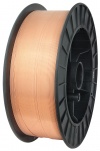
- SG2 - classification of welding wire according to European standards. SG2 means a universal wire that is commonly used for welding carbon and low-alloy steels.
- G3Si1 - classification of welding wire according to AWS (American Welding Society) standards, which specifies the chemical composition of the wire. G3Si1 means that the wire contains 3% manganese (G3) and 1% silicon (Si1).
- fi 0.8 mm – wire diameter.
- 5.0 kg – weight of wire on a spool.
Wire diameter:
Welding wires used in MIG/MAG processes come in various diameters, the most commonly encountered are: 0.6 mm, 0.8 mm, 1.0 mm, 1.2 mm. The choice of wire diameter depends on several factors, including the type and thickness of the material to be welded, as well as the welding position. When welding thinner materials, smaller diameter wires are usually used. For example, wires with a diameter of 0.6 mm and 0.8 mm are often used for welding thin-walled steel sheets and stainless steel. Wires with larger diameters, such as 1.2 mm or 1.6 mm, are suitable for welding thicker sheets and profiles, where higher current intensity is required.
- Wire with a diameter of 0.6-0.8 mm - Ideal for welding materials up to 4 mm thick.
- Wire with a diameter of 1.0-1.2 mm - Suitable for welding materials from 4 to 10 mm thick.
The choice of wire depends on:
- The type and thickness of the welded material,
- The required quality of the weld,
- Welding conditions,
- Welder's preferences.
Self-shielding FLUX welding wires
Referred to as FLUX welding wires or FCAW (Flux Cored Arc Welding), cored wires contain a core filled with metallic powders and chemical substances. The filling is responsible for the formation of shielding gas during the welding process, eliminating the need for additional gas from a cylinder. Particularly useful in outdoor conditions, where wind could disperse the external shielding gas.
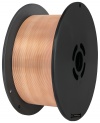
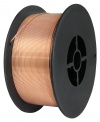
Wires for brazing:
The brazing method is particularly recommended for joining galvanized sheets with steel, as well as low- and non-alloy steels. The main advantage of the process is the ability to maintain the galvanic layer protecting the steel during welding, which is essential for ensuring corrosion protection. CuSi welding wires are used for brazing. This is an uncoated copper wire that, due to its silicon and manganese content, has good wetting properties and abrasion resistance. This wire is primarily used for brazing galvanized steel sheets and low-alloy steels, zinc-copper alloys, and low-alloy copper alloys. For brazing with CuSi wire, pure Argon is usually used as the gas, and during hard soldering - Argon with a 1% oxygen admixture.
When choosing welding wire, it is important to consider the type of welded material, its thickness, and the quality and strength requirements of the weld. We invite you to contact us by phone or email if you have further questions. We will be happy to answer them.