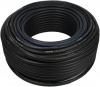
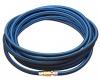
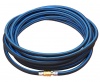
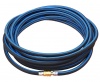
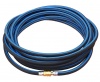
What are antistatic hoses?
Antistatic hoses for spray guns are special hoses that prevent the accumulation of electrostatic charges, minimizing the risk of sparks and potential ignitions during painting. They are crucial for safety in paint shops, especially when working with flammable materials.
Construction and operation:
Antistatic hoses typically have special additives or coatings in their construction that allow for the dissipation of electrostatic charges. These can include:
- Internal copper wires: Ensure electrical continuity and allow for the dissipation of charges from the hose.
- Conductive additives in the hose material: Allow for the dispersion of charges throughout the structure of the hose.
- Special external coatings: Can be made from conductive materials that prevent the accumulation of charges on the surface of the hose.
Advantages of using antistatic hoses:
Eliminate the risk of ignition of solvent vapors or other flammable substances, which is crucial in paint shops.
- Better quality of the paint coating:
Reduce the risk of defects caused by electrostatic discharges, such as chipping or unevenness.
- Protection against equipment damage:
Prevent damage to spray guns and other equipment caused by electrostatic discharges.
- Compliance with standards and regulations:
Many industries require the use of antistatic hoses to ensure safety and compliance with regulations.
Types of antistatic hoses:
- Pneumatic hoses: For transporting compressed air to power the spray gun.
- Hoses for paint material: For transporting paints and varnishes to the gun.
- Double hoses: Connecting the gun to the paint material feeder and air supply.
Additional information:
Antistatic hoses are available in various lengths and diameters, tailored to different needs and configurations of paint shops.
When choosing an antistatic hose, it is important to pay attention to its resistance to stretching, abrasion, chemicals, and temperature conditions.
It is important that the hose is properly connected and grounded to ensure effective charge dissipation.