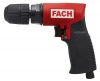
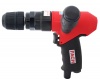
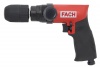
Description of the pistol drill construction:
- Body: Usually made of a lightweight but durable material, e.g., aluminum, with an ergonomic pistol-shaped handle.
- Pneumatic motor: Usually a vane type, powered by compressed air.
- Gearbox (optional): Some models may have a gear transmission that increases torque, particularly useful when drilling in hard materials.
- Chuck: Used to hold the drill bit.
- Air connection: The place for connecting the compressed air supply hose.
- Speed regulator: Allows for adjustment of the drill speed.
- Trigger/Switch: Starts the airflow and begins the operation of the drill.
Operating principle:
Power supply: The drill is connected to a compressor via a pneumatic hose.
Airflow: When the trigger is pressed, compressed air flows through the drill, reaching the pneumatic motor.
Motor drive: The air drives the vanes of the motor, causing it to rotate.
Power transfer: The motor's rotation is transferred to the spindle, on which the chuck is mounted.
Drilling: The rotating drill bit creates a hole in the material.
Speed adjustment: The available speed regulator allows for adjusting the drilling speed to the specific material and type of drill bit.
Advantages of pneumatic pistol drills:
- High power and torque: Allow for drilling in hard materials.
- Safety: The absence of electrical components eliminates the risk of electric shock and sparking, which is important in explosion-prone areas.
- Durability: Simple design and lack of electrical components contribute to high reliability and long lifespan.
- Ergonomics: The pistol shape facilitates work, especially in hard-to-reach places.
- Lightweight: Pneumatic drills are usually lighter than their electric counterparts.
- No overheating: Longer operation without worrying about overheating the motor.
Applications:
- Metal, wood, and construction industries.
- Automotive workshops.
- Installation of LPG systems.
Work requiring high precision and power.