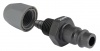
Composite pneumatic fittings are based on a combination of materials such as brass, polyamide, and plastics, with a clamping mechanism, seals, and a valve (in some models). They are used for quick and tight connections of compressed air lines in various branches of industry, such as machine manufacturing, automotive, medical, food, and chemical industries. Their main task is to ensure the safe transmission of air or other media in pneumatic installations while facilitating assembly and disassembly.
Construction of composite fittings
- Body: usually made of plastic (e.g., polyamide) or composite, which provides resistance to pressure and corrosion.
- Clamping mechanism: inside the body, there are clamping elements, often in the form of torches or rings, which clamp onto the hose when pressed, creating a tight connection.
- Release ring: the outer part of the fitting that allows manual release of the clamp and removal of the hose. Pressing the ring unlocks the clamping mechanism.
- Seal: usually made of NBR material, which guarantees the tightness of the connection.
- Valve (in selected models): inside the fitting, there may be a check valve (unidirectional or bidirectional), which automatically closes the air flow when the hose is disconnected.
- Thread: available in various types, e.g., external or internal thread, for connection with other installation elements.
Applications of composite fittings
- Industry: automation of production lines.
- Pneumatic tools (e.g., impact wrenches, spray guns, blow guns, tire inflators).
- Lubrication systems.
- Transmission of neutral gases.
- Distribution of compressed air in workshops.
What fitting to buy?
To properly select a pneumatic fitting, it should be matched to the type and parameters of the hose (e.g., diameter, material), ensure compatibility with the working pressure of the system, and choose the appropriate type of fitting (e.g., plug-in, screw) according to the application requirements, taking into account the working environment. Attention should also be paid to compatibility with the connected tool or device.
Criteria for selecting a fitting
- Type of fitting: The choice between different types depends on the needs:
- Plug-in fittings (quick couplings): Allow for quick and easy connection/disconnection of hoses, commonly used in pneumatics.
- Screw fittings: Provide a solid connection, often used in more challenging working conditions.
- Compatibility with the hose: Inner and outer diameter: Must be matched to the diameter of the hose.
- Hose material: The fitting should be compatible with the hose material, such as PU, nylon, or rubber.
- Working pressure: The fitting must be compatible with the working pressure of the pneumatic system.
- Working environment: Standard applications: Many plastic fittings are sufficient, they are lightweight and easy to install.
- Difficult conditions: Require the use of fittings made from damage-resistant materials, such as stainless steel, especially in industries such as food, pharmaceutical, or chemical, where resistance to corrosion and high pressures is needed.
- Type of connection: Clamping, push-in, or screw fittings – the choice depends on the installation method and application requirements.
- Functionality: Some fittings are equipped with a valve, allowing for quick disconnection of the hose under pressure, while others are valve-less (hard).