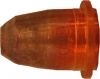
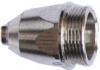
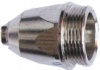
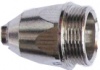
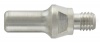
Description and application of plasma torch parts:
- Electrodes:
These are the components that experience the most wear during the cutting process. Proper selection and regular replacement are crucial for maintaining the quality and efficiency of cutting, as well as for ensuring workplace safety.
Description and function of electrodes:
- Initiating the plasma arc:
The electrode, along with the nozzle and other components of the torch, creates a system that, when voltage is applied and gas (e.g., air) flows, generates a plasma arc, which is a stream of hot ionized gas.
Materials:
Plasma electrodes are typically made from refractory materials, such as hafnium combined with copper.
Replaceable consumables:
Electrodes are consumable components, which require regular replacement to maintain cutting efficiency and quality.
- Application and signs of wear:
Main application: They are used in plasma cutters for cutting various metals.
Signs of wear: Reduced quality and accuracy of cutting, increased edge rounding, accumulation of slag, and edge deformation are signals indicating the need for electrode replacement.
Lifespan: Typically, the lifespan of electrodes ranges from one to three hours of operation, although it can vary depending on external factors.
- Nozzles for plasma torches:
Function:
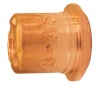
The nozzle in a plasma cutter concentrates the gas stream through which the pilot arc flows, facilitating its jump to the material being cut.
Material:
They are usually made of copper, which provides appropriate conductive and thermal properties.
Types:
- Standard nozzles: With varying hole sizes, where a smaller hole provides greater precision, and a larger hole is better for gouging.
- HD (High-Definition) nozzles: Designed for specialized plasma cutting systems, offering even higher cutting quality, tighter tolerances, and a sharper, narrower plasma beam due to special technologies.
Parameters:
Hole size (e.g., Ø 1.4 mm, Ø 1.1 mm) and current rating (e.g., 60-70A, 130A) are important parameters determining the application of the nozzle.
Application of nozzles for plasma torches:
The primary application is cutting various metals, from thin sheets to thicker materials, depending on the power of the cutter and the type of nozzle.
Nozzles with a larger hole are used for removing material to create a groove or gouge.
Precision machining:
Nozzles with a smaller hole allow for more precise cutting and shaping of the material.
CNC cutting systems:
HD nozzles are dedicated to numerically controlled plasma cutting systems, where high accuracy is required.
Examples of application: Plasma nozzles are used in cutters such as Magnum Cut 80, Cut 100, Cut 160, Sherman Cutter 110, Cutter 130, and other plasma cutters equipped with compatible torches (e.g., Trafimet A-101/141, PT-80).
Other consumables (spring rails, gas distributors, cooling tubes):
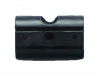
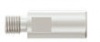
In addition to electrodes and nozzles, there are other parts in the plasma torch that also wear out and require periodic replacement to ensure optimal burner performance.
- Impact on the cutting process:
These components, when functioning correctly, allow for precise and efficient cutting of various materials. The stream of hot plasma generated by the torch enables rapid melting and blowing away of material, resulting in clean and accurate cuts.
- Maintenance and efficiency:
Having a stock of spare parts for plasma torches is recommended to ensure continuity of work and extend the lifespan of the equipment. Regular replacement of worn components prevents declines in cutting quality and potential failures.
- Applications in industry:
Parts for plasma torches are essential in many branches of industry, including automotive, shipbuilding, and metal construction, where plasma cutters are commonly used to cut elements of various sizes and thicknesses.