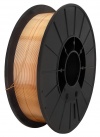
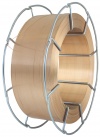
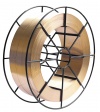
Description and types of MIG/MAG wires for brazing:
- CuSi3 wire:
This is the main wire used in brazing. It is a copper wire that is not coated with any layer.
- Application:
CuSi3 is used for joining thin, galvanized steel sheets, as well as for welding low-alloy and non-alloy steels and cast iron.
- Advantages of brazing with CuSi3:
- Corrosion protection of the joined elements.
- Lower welding temperatures, which minimizes the risk of burning the zinc coating.
- Reduced risk of porosity in the joints.
- Limitation of spatter formation.
- Shielding gas:
For brazing with CuSi3, it is recommended to use pure argon (Ar) as the shielding gas.
Brazing machine
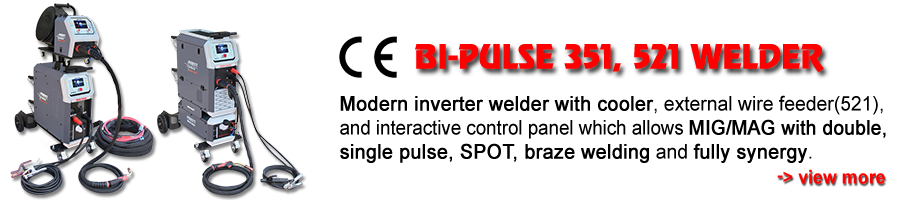
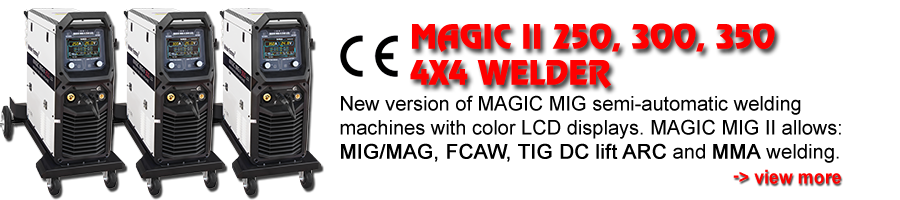
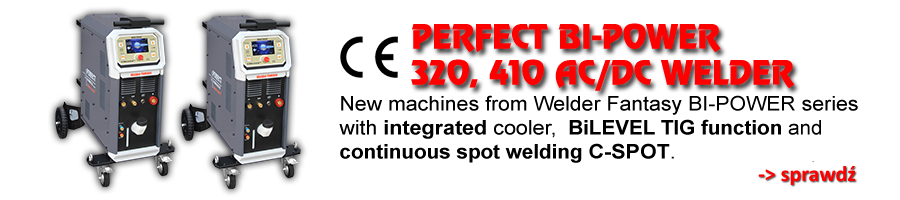
The best machines for brazing are MIG/MAG welders with a factory brazing option. These devices are specially designed to work with this wire and provide arc stability and maintenance of the appropriate arc temperature.
Essential features of a brazing welder:
- Current and voltage adjustment: The welder must allow for precise adjustment of current and voltage.
- Providing gas shielding: The welder must allow for the connection of shielding gas, most often pure argon. Shielding gas is essential to protect the joint from oxidation. The MIG welder or shielding gas regulator should allow for precise flow control.
Additional features of a brazing welder:
- Synergic settings: Welders with synergic function automatically adjust the working parameters to the selected settings, making the brazing process easier. You just need to select the material thickness and type of joint, and the welder will automatically choose the appropriate parameters.
- Pulsed mode: The pulsed mode allows for controlling the amount of heat introduced into the material. This is particularly important when brazing galvanized materials, as it minimizes the risk of damaging the zinc coating.
- Wire guide liner: A Teflon or graphite liner in the wire feeder facilitates the feeding of soft copper wire.
- Wire feeder rollers: The wire for brazing is more prone to kinking than welding wire for steel. It is recommended to use U-shaped rollers in the wire feeder, similar to those used for aluminum welding.
In summary, MIG/MAG wire for brazing, especially CuSi3, is an effective method for joining thin sheets, offering benefits such as corrosion protection and a lower risk of damaging the base material.
The brazing method is particularly recommended for joining galvanized sheets with steel, as well as low-alloy and non-alloy steels. The main advantage of the process is the ability to preserve the galvanic layer protecting the steel during welding, which is important for ensuring corrosion protection. Brazing wires CuSi are used for brazing. This is an uncoated copper wire that, due to its silicon and manganese content, has good wetting properties and abrasion resistance. This wire is primarily used for brazing galvanized steel sheets and low-alloy steels, zinc-copper alloys, and low-alloy copper alloys. Pure Argon is usually used as the gas for brazing with CuSi wire, and during hard soldering - Argon with a 1% addition of oxygen.