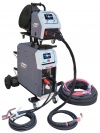
What are semi-automatic welding machines with water cooling?
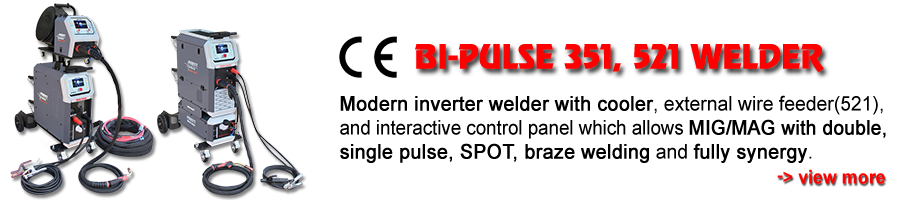
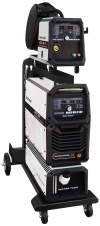
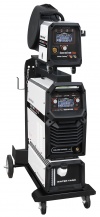
MIG/MAG welders with a separate feeder are devices in which the wire feeder is separated from the main body of the welder. This design provides greater mobility for the welder, making it easier to access hard-to-reach places, and improves work ergonomics. They operate on the principle of arc welding, where the arc glows between the melting electrode (welding wire) and the workpiece, and the shielding gas protects the weld from external factors.
Construction and operation:
Provides the power needed to create the welding arc. It can be powered from a three-phase (400V) or single-phase (230V) network. Most commonly with a power of 350-400A and above.
It is located in a separate housing and is connected to the power source via a welding cable. It feeds the welding wire to the torch at a regulated speed.
Contains a gas nozzle, current tip, and welding cable. The wire, shielding gas, and welding current flow through the torch, and the entire assembly is additionally cooled by fluid taken from the cooler.
Contains inert gas (e.g., argon) or active gas (e.g., carbon dioxide or gas mixtures), which protects the weld from oxidation and contamination.
Closes the electrical circuit, connecting the welder to the workpiece.
Principle of operation:
1. Arc formation:
When the trigger on the torch is pressed, the welding wire contacts the material, and the electrical circuit is closed. An arc is formed between the wire and the material.
2. Melting of the material:
The welding arc generates high temperature, which melts the welding wire and base material, creating a weld pool.
3. Gas shielding:
The shielding gas flows out of the torch nozzle, protecting the weld pool and welding area from contact with air.
4. Formation of the weld:
Once the weld pool solidifies, a weld is formed that joins the materials.
Advantages of MIG/MAG welders with a separate feeder:
Allow welding in hard-to-reach places and on large structures.
Allow for more comfortable handling of the torch, reducing welder fatigue.
Can be used for welding various materials, including steel, stainless steel, and aluminum.
In summary, MIG/MAG welders with a separate feeder are advanced devices that, due to their design and principle of operation, allow for effective and precise welding in various conditions.